
Menu
Impellers for pumps, fans and ventilation systems often feature complex 3D geometries with twisted blades and varying wall thicknesses. This type of design presents specific challenges in plastic injection moulding, where melt flow, cooling and tolerances must be managed with high precision.
Small deviations in the angle of the blades, the centring of the hub or the balance of the part can affect performance in the end application. Therefore, the injection moulding of impellers requires a controlled process and a well-thought-out mould design from the outset.
Injection moulding high-quality impeller parts requires careful consideration of material selection, melt flow, tool design, and post-processing.
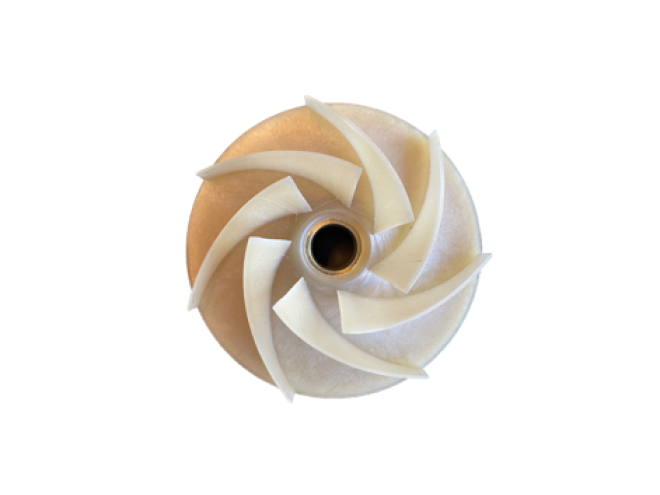
The manufacturing process begins with the injection of molten plastic into a tool designed for the impeller’s three-dimensional blade structure. The tool must accommodate both thin and thicker sections, whilst ensuring that the molten material reaches the entire area before it begins to solidify.
During the filling phase, the injection speed and pressure are controlled to ensure an even flow through the curved channels of the blades. This is followed by a controlled cooling phase, during which the part’s shape is stabilised before ejection.
The technique requires careful control of temperature, pressure profile and cycle time to ensure that each impeller is formed according to the defined geometry.
Moulding impellers with complex geometries requires that several technical parameters are aligned and work in harmony.
The choice of plastic material is based on requirements for strength, temperature resistance and chemical resistance, but also on the material’s flow properties. As impellers often contain thin, twisted blades, the molten material must be able to fill the tool without causing internal defects.
The tool must be designed to accurately capture the impeller’s three-dimensional structure. This includes accounting for the twist of the blades, the centre hole and any reinforcements, as well as the correct positioning of the inlet and cooling channels.
Uneven cooling can lead to deformation or imbalance in the part. The cooling process is therefore optimised to ensure that the impeller maintains its intended shape after demoulding.
When processes and tools are adapted to complex geometries, several key benefits are achieved in the production of injection moulded impellers.
With careful planning and the right methods, injection moulding ensures an exact capture of the blade geometry, whilst the hub’s centring ensures that the impeller meets all dimensional and measurement requirements.
A controlled process ensures consistent production, with every part meeting the specified dimensions and characteristics.
By selecting materials with the right mechanical properties, you can ensure that impellers retain their strength and functionality even under high loads in pump and fan systems.
Injection moulding is suitable for manufacturing impellers where there are high demands on durability under load, dimensional accuracy and consistent quality.
For this reason, the technique is widely used in industrial and consumer-oriented pump systems, fans, ventilation solutions and other HVAC components.
Idé-Pro has many years’ experience in manufacturing technically demanding plastic parts with complex geometries. Through optimised tool design, we ensure that all impellers meet the requirements for tolerances, balancing and strength.
Our in-house production facilities enable plastic injection moulding for both prototype and series production, offering high quality and great flexibility.
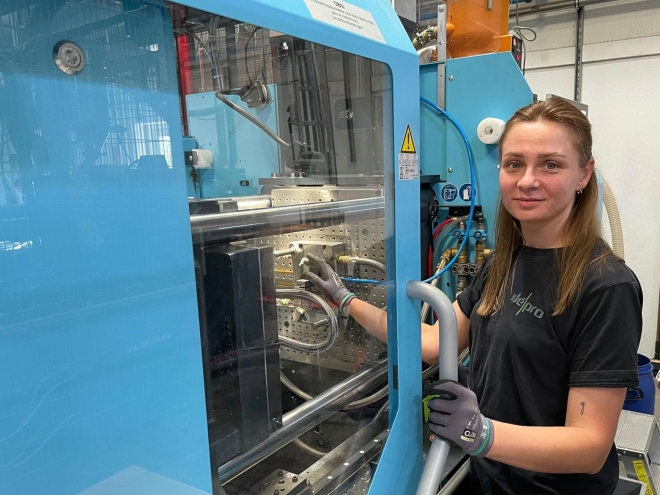
Do you have an impeller with complex geometry and demanding requirements? We can help you choose the right materials and geometries to ensure a consistent and efficient injection moulding process.
Get in touch and we’ll review your design and find the right solution for your part.