
Menu
If you need EPS or EPP parts, we can help with both development and moulding. We specialise in manufacturing highly complex parts, so we only need to mould a few parts to obtain a complete product.
We engage in close dialogue with the customer about part design, and with our knowledge of tool manufacturing, we can mould the exact parts that the customer need. No task is impossible.
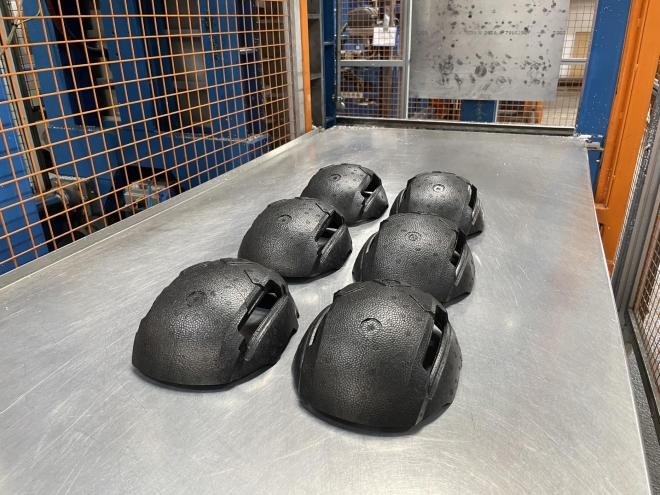
EPP is short for expanded polypropylene. It is a foamed material with a closed cell structure and is known for its light weight and impact-absorbing properties.
EPP is a versatile material that can be used in the finished product.
EPS is short for expanded polystyrene. EPS is a foamed material also known as Styrofoam, Styropor or Frigolit. EPS is known for its good insulating properties, low weight and low cost.
Like EPP, EPS can be incorporated into the finished product.
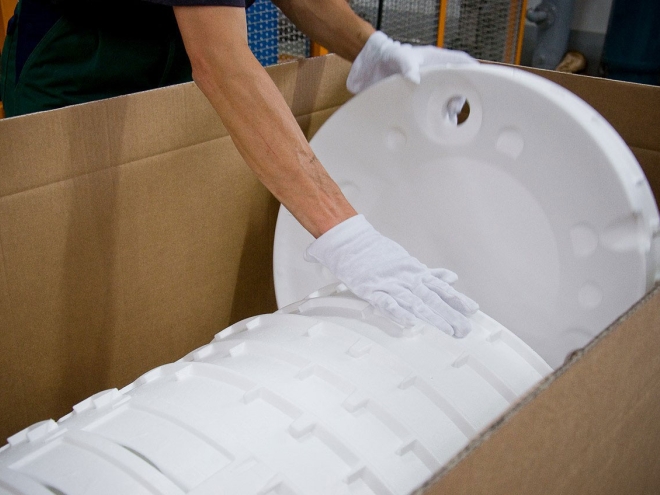
We always manufacture tools in aluminium for moulding EPS or EPP parts, as aluminium has the right thermal conductivity.
During the moulding of EPS and EPP parts, steam is used to expand and foam the plastic beads. That is why we produce the tools with thin plates and core- and steam valves to release the excess steam.
After EPP moulding, there may still be residual moisture and excess vapour in the parts.
Heat treatment in an oven helps to:
Not all EPP parts require post-treatment in an oven, but if the part is to be used in the automotive industry, for example, post-treatment is important to ensure that the part sets properly and retains its shape.
Additionally we have materials with and without flame retardants, with varying degrees of moisture absorption, and materials with increased impact absorption and flexibility.
Idé-Pro offers moulding of EPS and EPP parts with wall thicknesses from 6 to 100 mm and dimensions up to 1,300 x 800 x 700 mm. We have 6 moulding machines for EPS and EPP and specialise in producing parts with high complexity. All necessary competencies are available in-house – including tool manufacturing, moulding, post-processing and metrology laboratory.
Idé-Pro offers EPP and recycled EPP in black in densities of 40, 60 and 80 g/l. EPS is available in white and light grey in densities of 25, 50 and 75 g/l. We can also assist with other densities – contact us to find out more about the options available.
Yes. Idé-Pro always manufactures tools for EPS and EPP in aluminium, as aluminium has the right thermal conductivity for the process. An EPS and EPP tool is the mould used to give the part its final shape during moulding. The tools are manufactured with thin plates and core and steam valves to release excess steam.
The tool shop is equipped with fully automated milling machines and robots, and we have the capacity to produce up to 20 tools per week across injection moulding, high pressure die casting and EPS/EPP moulding on 3- to 6-axis milling machines with dimensions up to 2,100 x 4,000 x 1,200 mm and up to 20 T.
Idé-Pro's EPS and EPP moulding facility is located in Skive, Denmark. The facility is gathered under the same roof as our in-house tool shop, ensuring short lead times and high flexibility.
The price of EPS and EPP moulding at Idé-Pro varies from project to project and depends on factors such as part geometry, density, material selection, volume and any post-processing. We always find the solution that best meets requirements for cost, volume and finish.
Idé-Pro supplies moulded EPS and EPP parts to customers worldwide across industries such as automotive, energy, consumer and hi-tech. We have extensive experience with parts for demanding applications – from impact-absorbing EPP parts for electric vehicles and heat pumps to EPS parts for packaging and insulation – and act as a development partner from prototype to series production.
EPS (expanded polystyrene) and EPP (expanded polypropylene) are both lightweight foamed materials, but with different properties. EPS is known for its excellent thermal insulation and low cost, and is typically used for packaging and insulation. EPP offers superior impact absorption, chemical resistance and recyclability, and is used for more demanding applications such as automotive, ventilation and protective packaging. Idé-Pro offers moulding in both materials.
Yes. After EPP moulding, there may still be residual moisture and excess vapour in the parts. Idé-Pro offers heat treatment in an oven, which drives moisture out of the material, stabilises the shape of the part and prevents deformation over time. Post-treatment is particularly important for EPP parts intended for the automotive industry.
Yes. Idé-Pro is certified by Force Certification under ISO 9001 for the development and production of moulded EPS and EPP parts, and under ISO 14001 and ISO 50001 for environmental and energy management.