
Menu
The choice of injection moulding technique depends on the part’s function. To reduce weight, we use methods that reduce material consumption and produce lighter parts with the same strength.
When a part requires integrated features, such as moulded-in metal bushings or combinations of hard and soft materials, various 2K techniques are available where no post-assembly is required.
Injection moulding techniques are also available for complex geometries or requirements for in-mould labelling.
Idé-Pro offers a wide range of advanced injection moulding techniques, which make it possible to realise complex part designs that go beyond the capabilities of traditional injection moulding.
With our technical expertise and modern machinery, we take on the challenge and help you choose the right technique for your part.
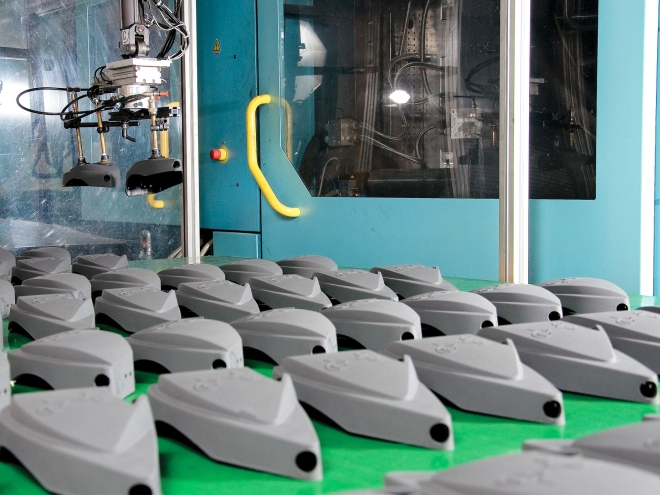
When the part design requires a low weight, or when large surfaces present challenges with sink marks, we use specialised techniques to control the flow of the material within the tool.
A technique in which gas, usually nitrogen or carbon dioxide, is injected directly into the molten plastic to create a lightweight, foamed structure within the part. This can reduce weight by up to 10–15 per cent and minimises the risk of sink marks, ensuring accurate dimensions even with complex geometries. Read more about plastic injection moulding with Ku-Fizz.
Nitrogen gas is injected into the molten plastic inside the tool to form internal channels. This creates strong yet hollow sections, which reduces material consumption and minimises the risk of deformation in sections with large wall thicknesses. Read more about gas injection moulding.
This method is particularly well suited to large, flat parts where you want to ensure a uniform surface finish without deformation, using a controlled distribution of the material.
To simplify the assembly process, we can combine different materials or integrate metal parts directly in the moulding process.
A robot automatically places metal bushings or threaded inserts into the tool before the plastic is injected around them. This integrates the bushings and inserts directly into the part, removing the need for subsequent manual assembly. Read more about 2K pick-and-place with metal bushings.
A technique that combines a hard PA6 base with a softer outer layer of TPU in on tool. This creates a durable bond between the hard and soft materials, making it ideal for ergonomic grips and seals. Read more about 2K injection moulding.
An advanced manufacturing process in which several different materials or colours are combined in a single part to meet visual and functional requirements.
Certain geometric shapes and visual requirements place specific demands on tool design and automation.
Moulding parts with twisted blades requires precise control of material flow and cooling to ensure balance and mechanical strength during use. Read more about impellers with complex geometries.
Labels are placed directly into the tool before the plastic is injected. During the injection moulding process, the label fuses with the plastic, creating a durable, integrated label that becomes part of the final part. Read more about in-mould labelling.
Choosing the right injection moulding technique requires in-depth knowledge of materials and technical expertise. We offer high capacity with injection moulding machines with clamping forces of up to 4,000 tonnes, and have installed Ku-Fizz systems on some of our larger machines to meet the demands of large, lightweight parts.
With our in-house tool factory and round-the-clock staffing, we can handle everything from prototypes to series production with great flexibility and fast delivery times.
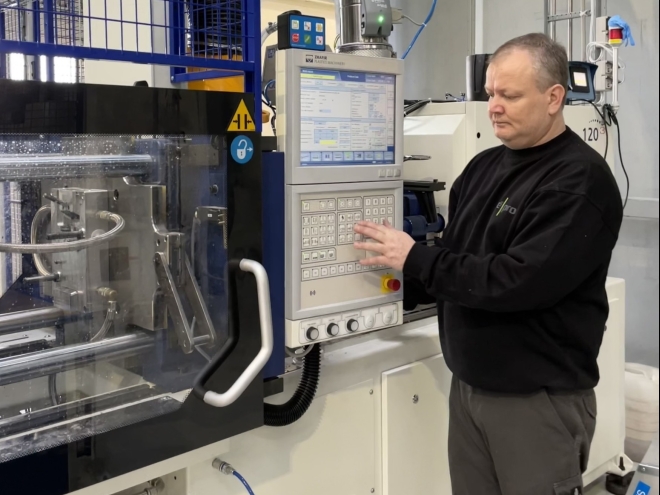
Are you unsure whether your part design is best realised using gas-assisted injection moulding, Ku-Fizz or 2K solutions? We can help you assess all the prerequisites from idea to finished product to ensure a successful end result.