
Menu
High pressure die casting is best when you need multiple identical parts, and when the prototype has to match the finished production part. CNC machining from a metal block is best for just a handful of parts, and when the design is still changing from day to day.
This article covers the advantages of each method, how they differ, and what they mean for part price, design and material use, so you can make a more informed decision about your own part.
The number of parts decides it in most cases. If you only need a handful, machining from block is cheapest. If you need multiple identical parts, high-pressure die casting becomes cheaper per part, because the tool is a one-off investment that can be tailored to exactly the number of parts you need.
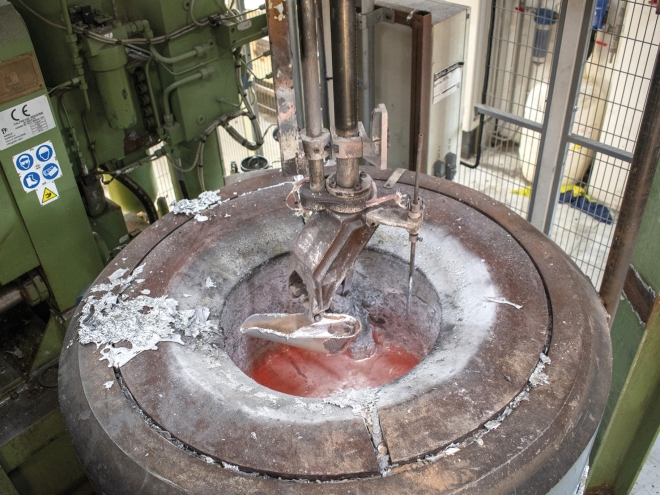
High pressure die casting fills a tool with molten light metal, while machining from block, as the name suggests, machines the part out of a solid metal block.
In high pressure die casting, molten metal is injected into a steel tool under very high pressure. It fills the tool cavity and solidifies before the tool opens. After casting, the part usually needs post-processing before it is ready for delivery, for example:
CNC machining is a subtractive process. Material is removed from a metal block until the part has its finished shape. A part machined from block also goes through post-processing such as deburring with Trowal and various surface treatments.
Both methods bring the part price down, but high pressure die casting brings it down faster and further.
With CNC machining from block, the machine spends the same time on every part. What brings the price down here is that setup and programming are paid for once and spread across the whole batch. The part therefore gets cheaper with volume, but only up to a point.
With high pressure die casting, most of the cost sits in the tool. The tool is a one-off investment, and the more parts it casts, the less the tool costs per part. So the part price keeps dropping. Once volumes pass a certain number, die casting becomes cheaper than machining from block, even though the tool itself is expensive.
Investing in a pre-hardened prototype tool early on also saves money. The sooner you have a functional prototype, the more design adjustments you can make before the production tool is built, and changes at that stage cost considerably more. The production tool is fully hardened, so any change requires spark erosion (EDM), welding, machining and hardening. Meanwhile production is at a standstill while the tool is out of the machine.
High pressure die casting can produce complex parts with thin walls and features such as ribs, while CNC machining from block suits parts where the wall thickness varies and where deep pockets have to be machined.
With high-pressure die casting, the tool decides the shape of the part. Wall thicknesses down to around 1 mm call for high pressure, high speed and a tool designed for it. The part also has to be ejected from the tool, which places some requirements on the part design:
These requirements are covered in our design guide, which covers optimal part design for high pressure die casting.
With machining from block, the cutting tool and the programming decide the shape of the part. Because the cutting tool is round, internal corners always have a radius. On the plus side, the wall thickness can vary freely, and the part can have vertical walls and sharp outer edges.
The two methods can produce the same part design when the part is relatively simple. At higher volumes they are often combined: it is die cast, and the tolerance-critical surfaces are machined afterwards.
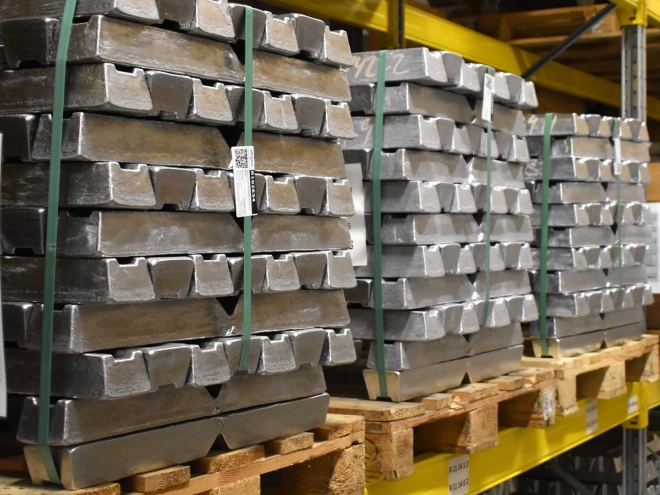
Machining from block uses more material per part. Often more than half of the metal block ends up as chips. The chips can be recycled, but they are contaminated with cutting fluid and have to be cleaned before they can be remelted. On top of that, you pay for the whole block, including the part that is milled away.
High pressure die casting also produces excess material. The inlets, runners and overflows fill with metal on every shot. That metal is clean, so it is remelted and used again.
The choice comes down to where you are in development: whether you need a handful of quick prototypes or several functional prototypes, or whether you are ready for low-volume production, and the volumes are high enough for high pressure die casting to make more sense economically.
Idé-Pro specialises in high pressure die casting and in tool manufacturing, with tools designed for prototypes and low-volume production. We help you assess when your part is ready to be cast. Contact Idé-Pro today, and we will take a look at your part together.
Prototypes from high-pressure die casting are delivered 5 to 8 weeks from a finished 3D file. Larger and more complex parts take 12 to 14 weeks, while Idé-Pro's Fast Track can have the first parts ready in 3 to 5 weeks, depending on size and complexity. Tool manufacturing and production are on the same site in Skive, which makes for a flexible process and keeps transport time down.
No, the design usually has to be adapted first. A part designed for machining from block can have features that prevent ejection. To be die cast, it needs draft angles as a minimum, so the part can be ejected from the tool.
Not quite. The cast part forms a dense outer skin as the metal solidifies against the tool, while the machined part has the uniform structure of the metal block all the way through. A part validated as a machined prototype can therefore behave differently once it is cast. That is exactly why it pays to have a functional prototype made in the right process before the production tool is built.