Menu
The choice between 3D printing and injection moulding depends on several factors. 3D printing is fastest and cheapest in the earliest development phase, when the design is still changing from one day to the next.
But injection moulding has a place in development too: with a prototype tool, you get parts in the actual production material, made with the actual production process, so function and material properties can be validated before you invest in a series tool.
This article covers when each method is the right choice, what technically sets them apart, and why injection molding can pay off for low volume production, sometimes from as few as 200 parts a year.
3D printing has no upfront tooling costs but a high per-part price, while injection moulding has high upfront tooling costs but a low per-part price. Beyond that, the choice comes down to how final the design is, the requirements on surface finish and tolerances, and which material the part needs to be manufactured from.
It all depends on your specific part and project, though. If you need 500 parts a year of a simple, non-critical part, 3D printing can still be the right choice. If you need 150 parts a year of a visible part with tight tolerances, injection moulding with a tool can still be the cheapest solution in the long run. A prototype tool can also pay off if it catches design problems before you invest in a series tool.
3D printing is additive manufacturing: the machine builds the part up layer by layer from a digital 3D model. There is no tool, no upfront tooling cost, and almost no geometric constraints. In return, each part is the result of a long, individual process, so the per-part price only drops marginally with volume.
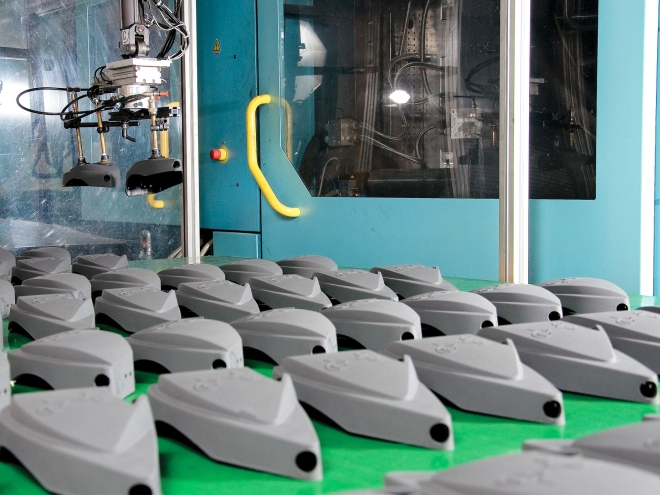
Injection moulding is a forming process: plastic granulate is melted and injected under high pressure into a tool. Once the plastic has cooled, the tool opens and the part is ejected. A typical cycle for a small part can take 15 to 60 seconds. Most of the cost sits in the tool. After that, the per-part price is low.
Injection moulding delivers a better surface finish, tighter tolerances, and a wider choice of materials than 3D printing.
Injection moulded parts come out of the machine with the surface finish of the tool. Polished tools give a high gloss, and textures can be etched directly into the tool. 3D printed parts can show visible layer lines, depending on the printing technology, and need sanding, filling, or painting to achieve the same finish.
Moulded parts still carry gate remnants and possibly weld lines, which need to be addressed in the design phase. That said, parts are usually ready to use with minimal post-processing, typically just trimming the gate and, where needed, deflashing.
Injection moulding typically holds tolerances within ±0.05 to 0.2 mm, depending on part size and material. FDM printing typically achieves ±0.2 to 0.5 mm, and SLS around ±0.3 mm.
With injection moulding, you can choose from virtually any thermoplastic, such as PP, ABS, POM, PA6, and PC/ABS, including glass-filled and flame-retardant grades. The range of materials available for 3D printing is more limited.
Yes, and often earlier than expected. 3D printing is often the go-to choice for low volume production. But for functional parts with visual requirements, it is not necessarily the cheapest solution.
Injection moulding for low volume production does not have to mean expensive tooling costs. At Idé-Pro, we typically see injection moulding become more competitive than 3D printing from around 200 parts a year, when the tool is built specifically for that purpose.
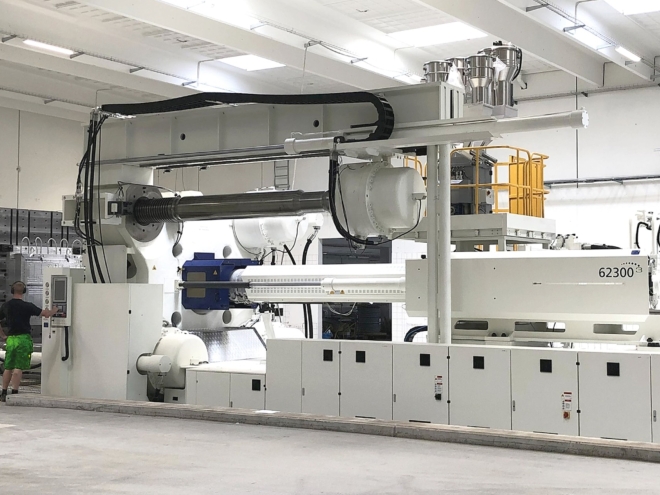
Whether 3D printing or injection moulding is right for your part depends on volume, requirements on surface finish and tolerances, and material choice. Idé-Pro can help with product development and builds the tools in house, with metrology and production all under one roof.
We are happy to assess which manufacturing method best suits your part. Send us your 3D file and get an assessment.
A tool for low volume production typically costs a fraction of a full production tool, because material choice, number of cavities, and level of automation are matched to the actual volume. Prototype tools for injection moulding are generally made from aluminium, which makes them cheap and quick to produce.
Typically from one week and up, from released design to the first parts. It depends, however, on the part's complexity and size, which varies from part to part.
No. A 3D printer places no requirement on the part being able to be ejected from a tool, so the design typically needs to be adapted with draft angles, uniform wall thickness, and radii.
Prototype tools for injection moulding are typically made from aluminium, which is faster and cheaper to machine than the tough-hardened or hardened steel typically used for series tools. We also have good experience with series tools in aluminium, tailored to the required volume. The parts are moulded in the same plastic in both cases and therefore behave the same way. The difference lies in the tool's lifespan, not in the part.
A tool delivers the same dimensions shot after shot, ensuring high repeatability. 3D printed parts vary more between units and between print jobs, because each part is built individually.