
Menu
When choosing a plastic material for injection moulding, there are seven parameters worth focusing on: the part's geometry and tolerances, mechanical load, temperature, electrical requirements, environment and surroundings, design and cost.
Choosing the material becomes easier if you start by looking at what the part will be used for rather than at the material itself. Once you have worked through the parameters, you will have a clearer picture of which material suits your part best.
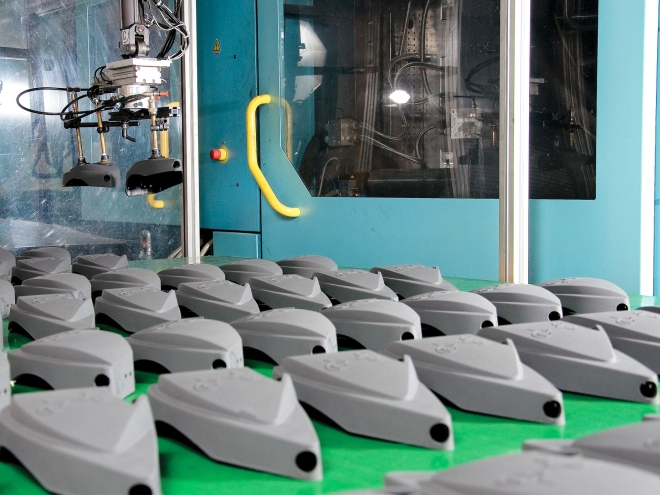
Below are the seven parameters. Use them as a checklist:
Which parameters matter most for the material choice depends entirely on the part. If it is to sit outdoors, UV and moisture may be the first things to look at. If you are in any doubt, we are happy to look at your part and advise you on material selection for injection moulding.
Start by looking at the part's geometry. Wall thickness drives the risk of warpage and sink marks, and sets the tolerances you can hold. Read more about wall thickness and cooling.
The material's shrinkage determines how much the part contracts as it cools, and it is compensated for in the tool. The rate varies by material: ABS typically 0.4 to 0.8%, POM 1.3 to 2.5% and PP 1 to 2%. Additives affect shrinkage too.
Wall thickness and material choice are therefore closely linked. A part with uneven wall thickness in a high-shrinkage material will rarely be dimensionally stable, however good the tool is.
With a short, high load, for example when a snap-fit clicks into place, tensile strength and impact strength are what matter. With a sustained load, for example a bracket carrying a constant weight, it is creep, meaning the part slowly gives way and only partly recovers. With a repeated load, for example a hinge or a gear, it is fatigue, where the part fails after many load cycles.
For high mechanical loads and heavy wear, PA6 and POM are both good choices. PA6 offers the highest tensile strength without fillers or glass fibre, typically 50 to 85 MPa measured dry as moulded, and it resists wear well. POM is slightly lower, around 50 to 70 MPa, but gives low friction, deforms little under sustained load and has good dimensional stability. That makes POM an obvious choice for moving parts such as gears, plain bearings and bushings, where the part has to maintain preload.
With 30% glass fibre, PA6 reaches 110 to 180 MPa, strong enough to replace light metals in some cases. The trade-off is that the part becomes more brittle. We injection mould technical plastics both with and without fillers and glass fibre.
A part sitting close to a motor or a power supply is warm for as long as the equipment is running. A part outdoors may alternate between frost in winter and solar heat in summer. And a part in a car can see well over 80 °C in the cabin on a hot day.
For sustained heat, PA6 and PC/ABS both handle up to around 110 °C, while ABS sits at 70 to 90 °C. If the part has to cope with thermal cycling, PC/ABS and PE are good choices, whereas PP tends to become brittle around freezing.
If your part needs a flame retardant, that shapes the material choice too. It affects mechanical properties, colour, surface and price. The UL 94 classification is stated for nearly all plastics.
If your part will sit in or around electronics, look at tracking resistance and static electricity.
Surface tracking starts as an unwanted leakage current that flows outside the intended circuit, often across insulating surfaces because of moisture, dirt or damage.
Because plastic insulates well, the part can build up a static charge. That attracts dirt and can damage the electronics. The solution is an antistatic additive or a conductive filler such as carbon.
PP and PE perform well electrically because they absorb almost no moisture and therefore keep their properties stable.
Cleaning agents and chemicals, moisture and UV from sunlight can all affect the material.
PP and PE withstand a wide range of chemicals and cleaning agents, which is why PP is common in healthcare and the food industry. PA6 is more sensitive to acids, and ABS is attacked by solvents and fats.
PA6 absorbs moisture from the air, which can make the part grow by up to around half a percent and leaves it tougher, while strength and stiffness drop. That means the part deflects more and its fit changes. POM is affected far less, and PP hardly at all.
UV from sunlight breaks down the surface, so the part chalks, yellows and becomes more brittle over time. For outdoor use, PP with a UV stabiliser is a good choice. Black pigment also protects well because it absorbs the UV at the surface.
The way you design the part also affects the material choice, from the colour and surface finish to the shape and any labels or printing. Some plastics are easier to colour than others, and some give a higher gloss. Others suit large surfaces better or take printing and labels more readily.
Colour: ABS is light and takes pigment readily, whereas POM is milky white and PA6 yellowish, so the material's own tone shows through and makes a specific colour harder to match.
Surface finish: amorphous plastics such as ABS and PC/ABS give the highest gloss, whereas PP, POM and PA6 give a more matt surface.
Shape: parts with larger surfaces can be prone to sink marks, and a low-shrinkage material such as ABS keeps them looking best.
Labels and printing: print adheres well to ABS, PC and PA6.
The economics of the material choice depend on price per kilo, density and cycle time. Material is paid for by weight, so the lower density of PP means a part weighs about a third less than the same part in POM. Cycle time matters because cooling accounts for most of it, and a shorter cycle gives more parts per machine hour.
If you have chosen a material because it is your default, it is worth revisiting that choice. A more expensive engineering plastic can sometimes be replaced by a cheaper base polymer with the right additive, for example PP with glass fibre or talc.
The seven parameters give you a good starting point for choosing a suitable material. Idé-Pro is happy to advise on that choice, so you get the best possible part for your requirements.
POM. It has low friction, deforms little under sustained load and holds its dimensions over time, which makes it a good fit for gears, plain bearings and bushings.
PA6 and PC/ABS withstand the most, typically up to 110 °C in continuous use. ABS sits at around 70 to 90 °C. Note that these figures are for sustained heat. A brief spike can be much hotter without damaging the part.
Yes, in some cases. If a part needs to be lighter, aluminium can often be replaced by glass-fibre-reinforced PA6, for example in brackets, mounts or pump housings. In the automotive industry, the switch can also be the most sustainable choice, because a lighter vehicle uses less fuel over its service life.
PP with a UV stabiliser is a good choice, ideally in black, since the pigment absorbs the UV at the surface. PP itself also takes up almost no moisture.
Typically between 0.4 and 2.5%, depending on the material. ABS shrinks 0.4 to 0.8%, POM 1.3 to 2.5% and PP 1 to 2%. Shrinkage is compensated for in the tool, so it is the variation that sets the limit on tolerances.