
Menu
Varying wall thickness and uneven cooling in the tool are the main causes of internal stresses, warpage and surface defects in injection moulded parts. By designing parts with smooth wall transitions and applying a method such as physical foaming with Ku-Fizz, shrinkage can be counteracted. This ensures that the finished parts stay within tolerance throughout the production run.
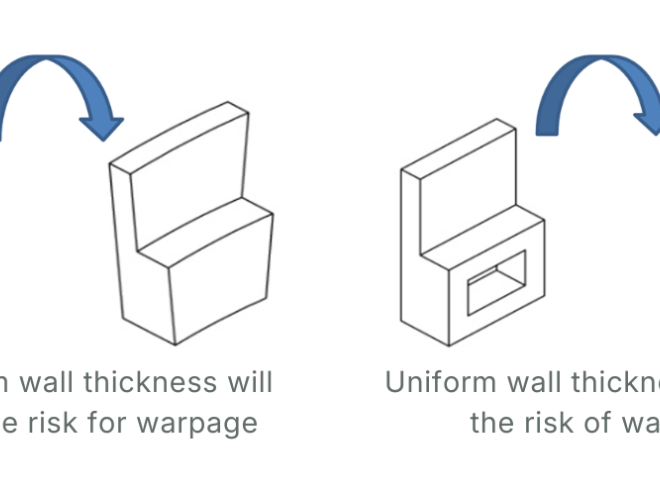
When you develop technical plastic parts, the work between CAD drawing and production is decisive for the final result. Understanding how the plastic behaves inside the tool is essential if you want to achieve and maintain tight tolerances. Two factors help govern that behaviour: the part wall thickness and how evenly the material is cooled.
When manufacturing plastic parts, you should aim for a uniform wall thickness throughout the part in order to reduce the risk of warpage. You can also design the part so that it compensates for warpage, giving a straighter moulded part. A Moldflow warpage analysis can help predict how much compensation the part requires.
If your design includes ribs, there is a risk of sink marks. The wall thickness of a rib should be no more than half of the wall thickness it sits on — for example 1.25 mm on a wall thickness of 2.5 mm. The thicker the ribs, the greater the risk of sink marks. The thinner they are, the greater the risk of incomplete filling of the ribs and warpage.
Thick sections should be cored out. The thickest section often determines the cycle time and therefore affects the price.
During injection moulding, when molten plastic is injected into a tool, the material immediately begins to cool and shrink. If the cooling is not completely even, temperature differences arise in the material, which leads to internal stresses.
The stresses are released as the part is ejected from the tool and finishes cooling. This is where the plastic risks warping if the cooling process is not controlled. Warpage does not necessarily show up straight away.
In semi-crystalline materials such as PP, PA and POM, shrinkage continues for hours or days after moulding, and a part that looks correct at ejection can still change before it is measured. Controlled cooling is therefore one of the most important steps in ensuring good dimensional stability in the plastic part.
For complex parts where thick sections or large surface areas are required, various injection moulding techniques can be applied to meet the requirement.
Ku-Fizz is a technique where nitrogen or carbon dioxide is added directly to the melt. This creates a light, foamed core inside the part during moulding. It counteracts shrinkage and reduces sink marks, while lowering the weight by up to 10-15%.
Here, nitrogen is injected into the warmest core of the melt during the moulding cycle. The gas pressure pushes the plastic out against the tool walls and is actively maintained through part of the cooling phase. The result is a strong, lightweight part that is fully or partly hollow, with a low risk of sink marks. The technique is used for handles and grips, among other applications.
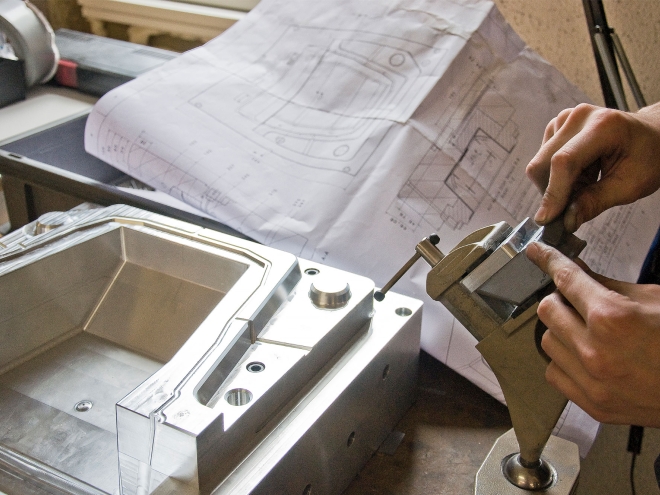
The design of the tool determines how well the cooling can be controlled. Integrating cooling channels that follow the geometry of the part keeps the temperature even throughout the process.
When developing new parts, an aluminium prototype tool is a sensible step. Unlike traditional tools in hardened steel, aluminium makes it possible to test quickly and at lower cost how the chosen material actually shrinks, before the production tool is finalised.
Idé-Pro has extensive experience with injection moulded plastic parts for both prototypes and series production. With an in-house tool shop and a modern machine park, we help you optimise your design and find the right production method. Contact us for technical advice or a quotation for your next project.
Plastic parts warp when they do not cool evenly. A uniform wall thickness helps ensure that the entire part cools at the same rate. If some areas cool more slowly than others, temperature differences create internal stresses that are released when the part is ejected from the tool, pulling the part out of shape. Uneven wall thickness and uneven cooling in the tool are therefore the main causes of warpage.
Sink marks are small indentations in the part surface. They can occur when the plastic inside the part shrinks more than the already solidified outer skin. Sink marks typically appear where the wall thickness is large, at material accumulations, or where ribs are too thick.
A rib should be no more than half as thick as the part's wall thickness, for example 1.25 mm on a wall thickness of 2.5 mm. If the rib is thicker, the risk of sink marks increases. If it is thinner, you risk underfilled ribs and warpage.
A Moldflow warpage analysis is a simulation of how the plastic fills, cools and shrinks in the tool. It predicts how much the part will warp and in which direction, before the tool is made. The results are used to compensate the part dimensions and to optimise gate location and cooling, so that the part is straight after moulding.
In semi-crystalline materials such as PP, PA and POM, shrinkage continues for hours or days after moulding, known as post-mould shrinkage. A part that measures correctly at ejection can therefore still move. Amorphous materials such as ABS and PC stabilise faster. Only measure the part once it has stabilised.